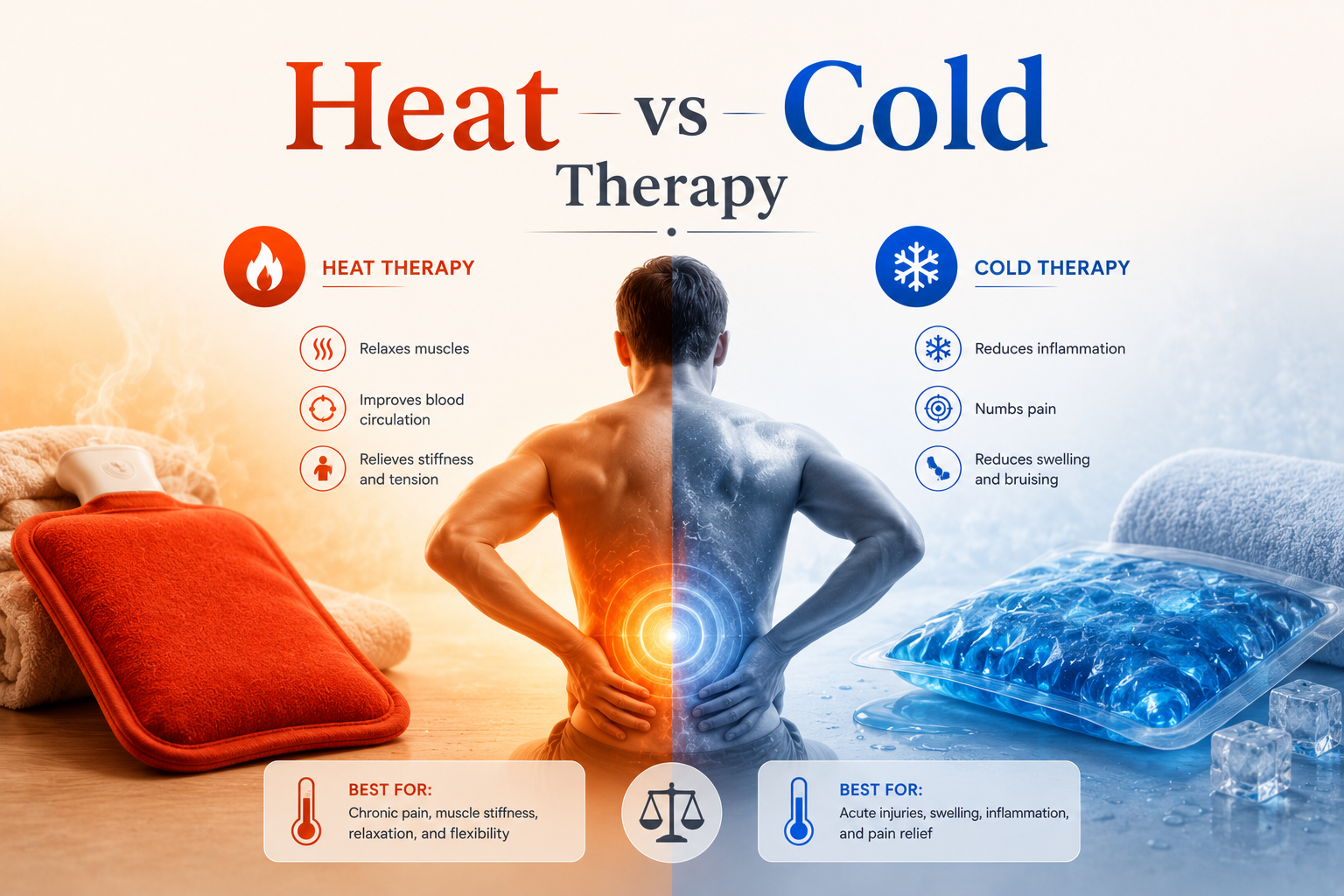
Heat vs Cold Therapy: The Physiological Rationale Behind Two Essential Physical Therapy Modalities
Understand the physiology behind heat and cold therapy in physical therapy — when to use each modality, how they work, and what the science says about their effects on healing.
“Should I put ice or heat on it?” It is one of the most common questions physical therapists receive. The answer, according to modern physiology and clinical evidence, is nuanced — and the choice between heat and cold therapy (thermotherapy and cryotherapy) should be based on the biological state of the tissue, the treatment goal, and the individual patient’s presentation.
Both heat and cold are among the oldest therapeutic interventions in human history. Modern physical therapy has refined their application with a deeper understanding of how temperature affects blood flow, nerve conduction, tissue extensibility, enzyme activity, and the inflammatory process. This article explains the physiology behind both modalities and provides a clear evidence-based guide for when each is appropriate.
The Physiology of Cold Therapy (Cryotherapy)
Cold therapy involves applying temperatures below normal body temperature to body tissues. Typical methods include ice packs, ice massage, cold-water immersion, and more recently, cryotherapy chambers. Standard cold therapy application in clinical practice involves temperatures of approximately 5–15°C (40–60°F) applied for 10–20 minutes.
Physiological effects of cold:
Vasoconstriction: Cold causes smooth muscle in blood vessel walls to contract, narrowing the vessel lumen. This reduces blood flow to the cooled area, limiting the delivery of inflammatory mediators, immune cells, and fluid — helping control swelling in the acute phase of injury.
Reduced nerve conduction velocity: Cooling decreases the speed and frequency of nerve impulse transmission. This affects pain-carrying fibers (both Aδ and C fibers), reducing the intensity of pain signals reaching the spinal cord. This is the primary mechanism of cold-induced analgesia — why ice provides effective, temporary pain relief.
Reduced metabolic rate: Lowering tissue temperature slows enzyme-catalyzed reactions, reducing the metabolic activity of cells in the cooled area. This reduces cellular oxygen demand and may limit secondary injury (cell death in the zone surrounding the primary injury due to oxygen deprivation).
Muscle relaxation: Cold reduces muscle spindle activity and motor nerve conduction velocity, temporarily reducing muscle tone. This can provide short-term relief from acute muscle spasm.
Reactive hyperemia: After cold application is removed, blood vessels dilate in response to the preceding vasoconstriction — a reflex called reactive hyperemia. This produces an increase in blood flow that may help flush inflammatory metabolites from the tissue.
Clinical indications for cold therapy:
- Acute injuries (0–72 hours): Cold is appropriate for pain management in the acute inflammatory phase. It reduces swelling, pain, and muscle spasm associated with the initial injury response.
- Post-exercise soreness: Cold water immersion and local ice application reduce DOMS symptoms.
- Acute flare-ups of chronic conditions: When a chronic condition has an acute inflammatory episode.
Cautions with cold therapy:
- Prolonged or excessive cold application can damage tissue (frostbite).
- Cold may excessively suppress the inflammatory response needed for healing if used too aggressively in the early days.
- Contraindicated in areas with impaired circulation (peripheral vascular disease, Raynaud’s phenomenon).
- Should not be applied to open wounds.
- Patients with cold allergy (cold urticaria) should avoid cold therapy.
The Physiology of Heat Therapy (Thermotherapy)
Heat therapy involves applying temperatures above normal body temperature to body tissues, typically 40–45°C (104–113°F) for superficial application, or higher temperatures reaching deeper tissue with modalities like therapeutic ultrasound and shortwave diathermy. Methods include hot packs, warm towels, paraffin wax baths, hydrotherapy, and therapeutic ultrasound.
Physiological effects of heat:
Vasodilation: Warmth causes smooth muscle in blood vessel walls to relax, widening vessel lumen. This increases local blood flow, delivering more oxygen, nutrients, growth factors, and immune cells to the tissue while removing metabolic waste products more rapidly.
Increased metabolic rate: Higher temperatures accelerate enzyme-catalyzed reactions, increasing cellular metabolic activity. For every 1°C increase in tissue temperature, metabolic rate increases by approximately 10–13%. This can enhance the efficiency of tissue repair processes — if healing is already underway.
Increased tissue extensibility: Heat reduces the viscosity of collagen, making connective tissue more pliable. Tendons, ligaments, joint capsules, and muscles become more extensible at elevated temperatures — reducing the force required for stretching and improving range of motion.
Reduced muscle spasm: Heat has an analgesic effect mediated partly through thermoreceptor stimulation (gate control, similar to other non-painful sensory input) and partly through the relaxing effect of warmth on muscle spindles. Muscle guarding and spasm — common in subacute and chronic musculoskeletal presentations — are often significantly reduced by local heat application.
Improved pain tolerance: Heat activates TRPV1 and TRPM8 thermoreceptors in the skin and underlying tissues, which modulate pain signal processing at the spinal cord level. Additionally, heat application stimulates the release of endorphins — contributing to systemic analgesia.
Clinical indications for heat therapy:
- Subacute and chronic musculoskeletal conditions: Once acute inflammation has subsided (typically after 48–72 hours), heat is appropriate for pain management, muscle relaxation, and tissue preparation for exercise.
- Muscle spasm: Chronic muscle tightness and guarding respond well to heat.
- Joint stiffness: Pre-exercise heat application improves joint extensibility and reduces the effort required for range-of-motion exercises.
- Warming up tissue before manual therapy or stretching: Heat increases tissue extensibility, making subsequent manual therapy and therapeutic exercise more effective and comfortable.
Cautions with heat therapy:
- Must not be applied to acute injuries with significant swelling (first 48–72 hours) — heat vasodilation increases fluid movement into already-swollen tissue.
- Contraindicated in areas with impaired sensation (risk of burns without pain warning).
- Avoid in areas with active infection, malignancy, or deep vein thrombosis.
- Contraindicated in areas with bleeding disorders or significant coagulopathy.
- Do not apply to open wounds.
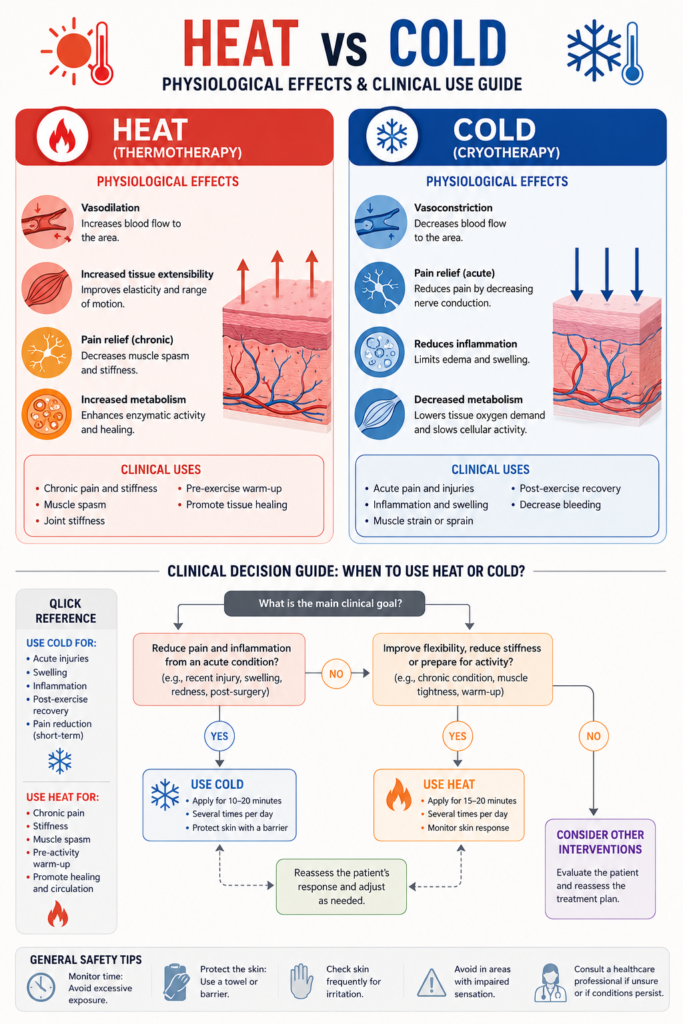
The Contrast Between Modalities: A Clinical Decision Framework
| Feature | Cold Therapy | Heat Therapy |
|---|---|---|
| Blood flow | Decreases (vasoconstriction) | Increases (vasodilation) |
| Best for | Acute injury (0–72 hrs), DOMS | Subacute/chronic, pre-exercise warm-up |
| Pain mechanism | Reduces nerve conduction | Gate control + endorphin release |
| Swelling effect | Reduces (limits exudate) | Can worsen if used acutely |
| Muscle spasm | Short-term reduction | Longer-term relaxation |
| Tissue extensibility | Decreases | Increases |
| Metabolic rate | Decreases | Increases |
Modern Perspectives: Questioning the Evidence
It is important to acknowledge that while the physiological rationale for both modalities is well-established, the clinical evidence for specific applications is more variable than traditionally assumed.
The original RICE protocol has been revised — aggressive icing is no longer universally recommended for acute injuries, as some evidence suggests it may prolong recovery by excessively suppressing the inflammatory response needed for healing. Current guidelines suggest using cold primarily for pain management rather than healing acceleration, and only as needed rather than reflexively.
Heat therapy likewise has strong physiological rationale and widespread patient acceptance, but high-quality clinical trials are limited for many specific indications.
Physical therapy practice appropriately combines physiological reasoning, clinical evidence, individual patient response, and shared decision-making to guide modality use. “What feels better?” is not an unscientific question — the nervous system’s response to thermal input is a genuine physiological signal worth considering.
Combined Approaches
Some physical therapists use contrast therapy — alternating cold and heat — to produce a “pumping” effect on local circulation through alternating vasoconstriction and vasodilation. While the clinical evidence is limited, the physiological rationale is plausible for conditions where local circulation improvement is a primary goal.
Conclusion
Heat and cold are powerful physiological tools — influencing blood flow, nerve conduction, tissue extensibility, metabolic rate, and pain experience in ways that are scientifically well-understood and clinically useful. The key is applying the right modality at the right time, for the right patient, with the right goals.
Cold for acute injury — to manage pain and control swelling during the inflammatory phase. Heat for subacute and chronic conditions — to promote blood flow, relax muscle, improve extensibility, and prepare tissue for therapeutic exercise. Both modalities are most effective when used as part of a comprehensive physical therapy program, not as standalone treatments.
The physiology behind these tools is the same physiology underlying all of physical therapy: working with the body’s biological mechanisms rather than around them to support healing, function, and recovery.
References
- Hall, J.E., & Hall, M.E. (2020). Guyton and Hall Textbook of Medical Physiology (14th ed.). Elsevier.
- Cameron, M.H. (2017). Physical Agents in Rehabilitation: From Research to Practice (5th ed.). Elsevier.
- Costanzo, L.S. (2022). Physiology (7th ed.). Elsevier.
Disclaimer: This article is for educational purposes only and does not constitute medical advice. Always consult a qualified healthcare professional for personal health concerns.
The site is written and curated by Paul Morgan, a graduate in Physiotherapy (2026), with a particular interest in cardiorespiratory and musculoskeletal physical therapy. Every article on this site is grounded in academic physiology and physical therapy coursework. Content reviewed for clinical accuracy before publishing.