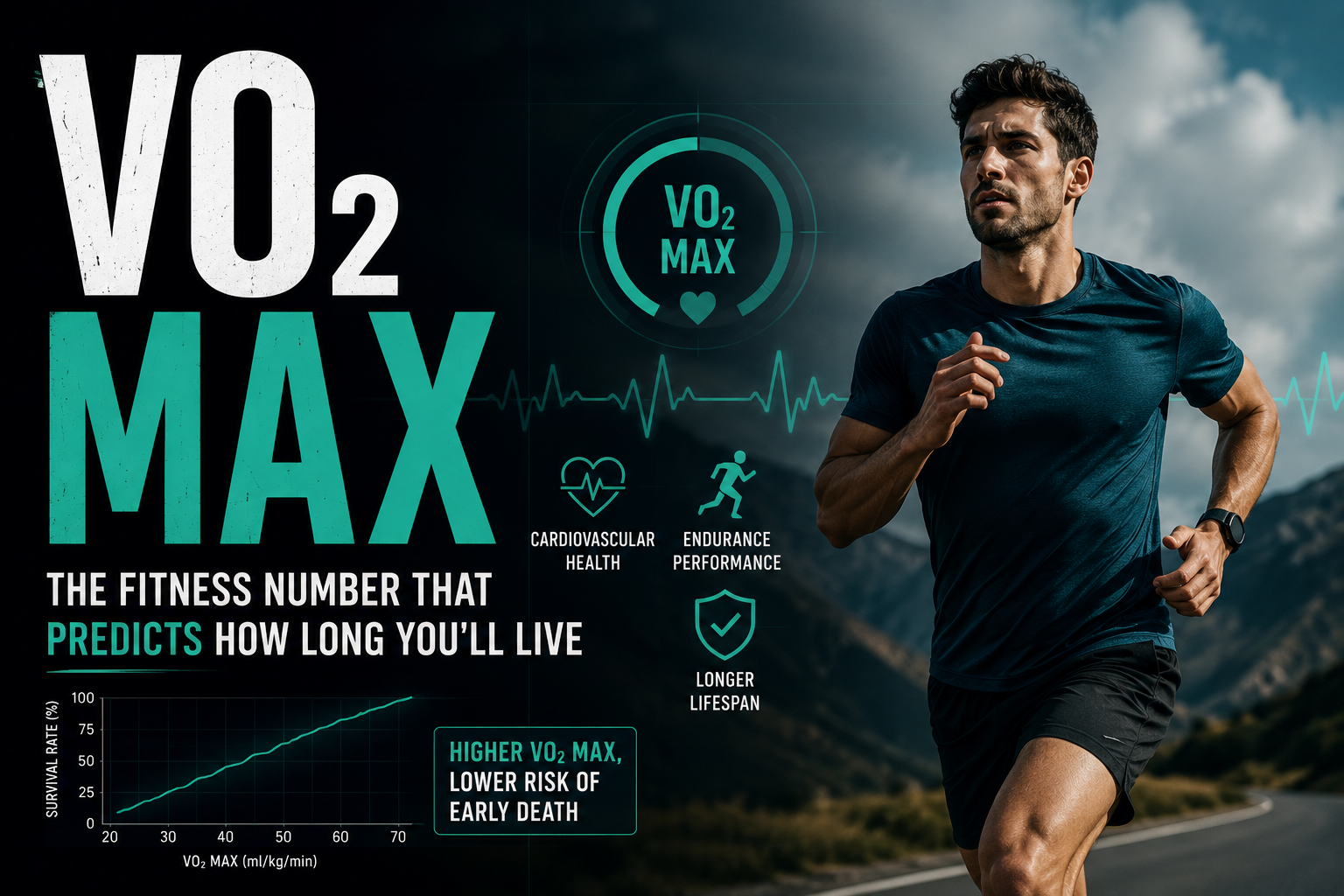
VO2 Max: The Fitness Number That Predicts How Long You’ll Live
VO2 max predicts long-term mortality better than smoking, diabetes, or hypertension — yet almost nobody measures it. Here’s what it is, why the heart is the real bottleneck, and how the evidence says to train it.
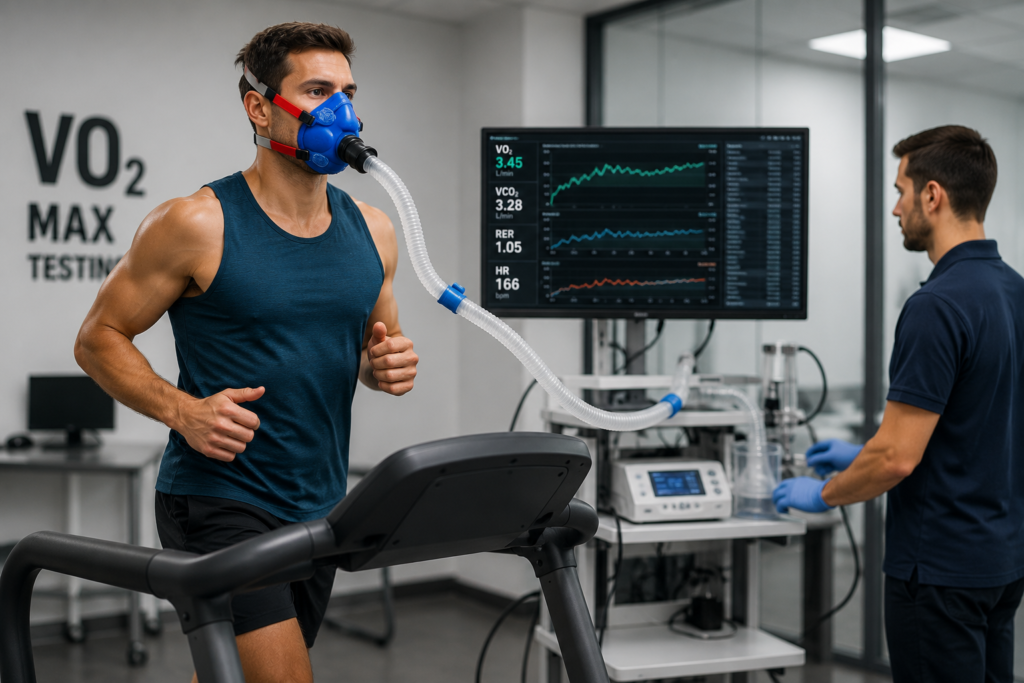
Ask most people about their health numbers and they’ll rattle off blood pressure, cholesterol, maybe resting heart rate. Almost nobody mentions VO2 max: the maximum amount of oxygen their body can take in, transport, and use during intense exercise. That’s despite a growing body of research placing it among the strongest single predictors we have of how long someone is likely to live.
The Problem
VO2 max is rarely measured outside sports labs and cardiology clinics, so a low value can sit unnoticed for years, quietly reflecting a cardiovascular system with very little reserve. Unlike blood pressure or cholesterol, it doesn’t show up on a routine blood panel — it takes a graded exercise test to see it directly, which is precisely why most people never learn their number until a doctor orders one for another reason.
That blind spot matters more than it should. In a review of the physiology of maximal oxygen uptake, Bassett and Howley describe VO2 max as the best single index of the entire oxygen-delivery system’s capacity, from lungs to working muscle [1]. When that capacity is low, it isn’t just a performance limitation — it’s a measurable cardiovascular risk that stays invisible until it’s tested for.
Why It Happens: The Evidence
VO2 max depends on four links working in sequence: the lungs bring oxygen into the blood, the heart pumps that blood out, the blood carries the oxygen to the tissues, and the muscle fibers extract and burn it. A weakness anywhere in that chain caps the whole system, but not all four links limit the system equally.
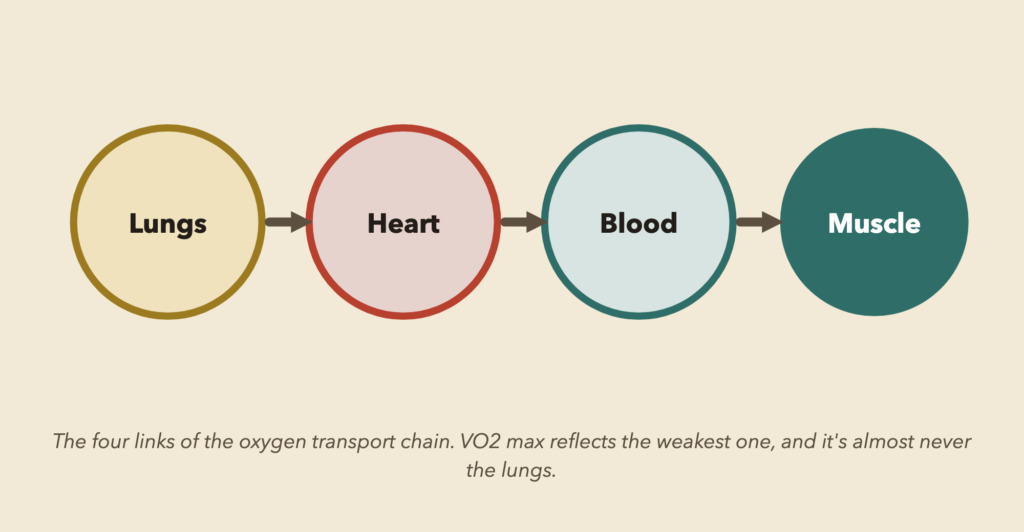
Except in trained endurance athletes or people with lung disease, the lungs are almost never the limiting factor — they typically supply more oxygen to the blood than the rest of the system can use. The link that usually sets the ceiling is the heart, specifically how much blood it can pump per minute at maximal effort (maximal cardiac output). Bassett and Howley’s review walks through the evidence for this directly: artificially raising the oxygen content of inhaled air barely changes VO2 max, but interventions that raise maximal cardiac output raise it substantially [1]. The lungs have slack to spare; the heart doesn’t.
That same review addresses a common assumption: that VO2 max is essentially fixed by genetics. Twin and family studies summarized there attribute roughly half of the variation between individuals to inherited factors — real, but far from the whole story. The other half is trainable, which is exactly why the same review, and others since, treat VO2 max as a modifiable risk marker rather than a fixed trait.
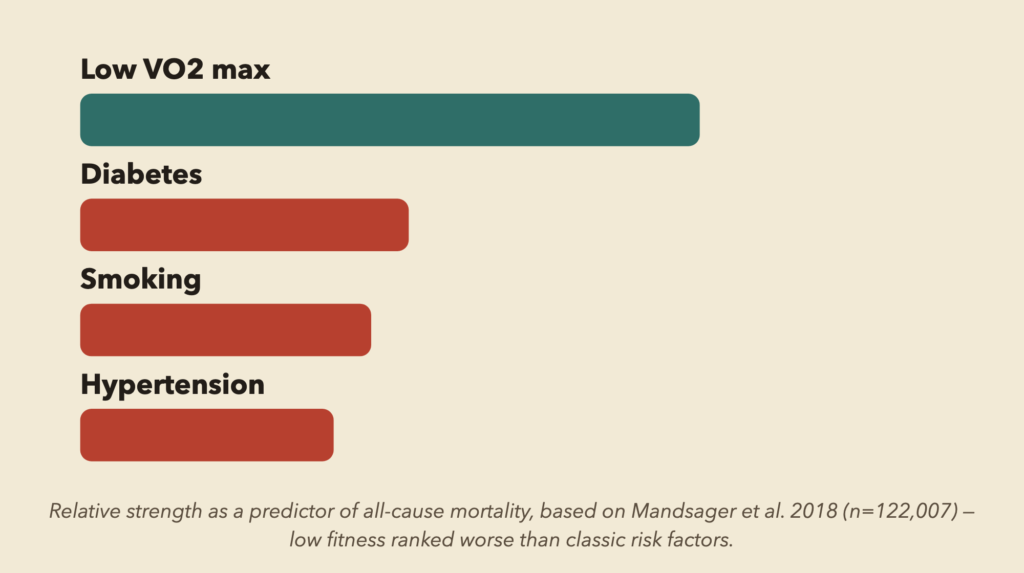
The stakes of that modifiable half are large. A study of more than 122,000 adults who underwent treadmill testing at a major U.S. medical center found that cardiorespiratory fitness had a strong, graded, inverse relationship with death from any cause, with the least-fit group carrying a risk of death comparable to or higher than that of smokers, and no observed upper limit to the benefit of higher fitness [3]. That evidence, among other studies, led the American Heart Association to formally recommend that cardiorespiratory fitness be assessed as a clinical vital sign, on par with blood pressure and the other numbers already checked at every visit [2].
The Solution
If maximal cardiac output is the real ceiling, the training that raises it is what moves VO2 max the most. A meta-analysis pooling human training studies found that both continuous moderate-intensity training and high-intensity interval training (HIIT) reliably increase VO2 max, with HIIT protocols producing the largest average gains per unit of training time, though both approaches work and combining them outperforms either alone [4].
The two methods raise VO2 max through different, complementary mechanisms. Long, steady sessions at a conversational pace (often called “zone 2”) build capillary density and mitochondrial content in the muscle, improving how efficiently the muscle extracts and uses the oxygen it’s given. Short, hard intervals push heart rate and stroke volume to their ceiling repeatedly, which is the more direct route to raising maximal cardiac output itself — the link identified above as the usual bottleneck.
Exercises
- Zone 2 base session: 40-60 minutes of continuous cycling, running, or brisk incline walking at an intensity where you could still hold a conversation in short sentences. Aim for 2-3 sessions a week; this is the volume work that builds the muscle’s capacity to use oxygen once it arrives.
- 4×4 interval protocol: After a 10-minute warm-up, alternate 4 minutes at a hard, sustainable-for-4-minutes effort with 3 minutes of easy active recovery, repeated 4 times. Done once or twice a week, this is one of the most-studied protocols for raising maximal cardiac output directly.
- Progression, not intensity for its own sake: Increase interval duration or reduce recovery time gradually over weeks rather than jumping straight to maximal effort — the adaptation comes from consistent, repeatable sessions, not from a single exhausting one.
Supporting video
Traces the path oxygen takes from lungs to working muscle using real cadaver dissection — watch it in full before linking it, to confirm it matches the mechanism described above.
This article is general information and does not replace an individual assessment. Anyone starting high-intensity interval training for the first time, or with existing cardiovascular disease, should check with a doctor before beginning, and a formal VO2 max test should be administered and interpreted by qualified lab or clinical staff.
References
- Bassett DR Jr, Howley ET. Limiting factors for maximum oxygen uptake and determinants of endurance performance. Med Sci Sports Exerc. 2000;32(1):70-84. PMID: 10647532. PubMed ↗
- Ross R, Blair SN, Arena R, et al. Importance of Assessing Cardiorespiratory Fitness in Clinical Practice: A Case for Fitness as a Clinical Vital Sign. Circulation. 2016;134(24):e653-e699. PMID: 27881567. PubMed ↗
- Mandsager K, Harb S, Cremer P, Phelan D, McCarthy JJ, Jaber W. Association of Cardiorespiratory Fitness With Long-Term Mortality Among Adults Undergoing Exercise Treadmill Testing. JAMA Netw Open. 2018;1(6):e183605. PMID: 30646252. PubMed ↗
- Bacon AP, Carter RE, Ogle EA, Joyner MJ. VO2max trainability and high intensity interval training in humans: a meta-analysis. PLoS One. 2013;8(9):e73182. PMID: 24066036. PubMed ↗