

Why Hamstring Strains Keep Sidelining World Cup 2026 Stars
Salah and Raphinha are the latest hamstring casualties of the 2026 World Cup. We break down why this injury dominates elite football, and what rehab and prevention actually work, according to the research.
Halfway through the knockout rounds of the 2026 World Cup, the injury list is starting to look familiar. Mohamed Salah went off with a hamstring strain against Iran. Raphinha followed with the same injury in Brazil’s group stage. Different teams, different legs, same muscle group — and that’s not a coincidence. Hamstring strains are, by a wide margin, the single most common injury in men’s professional football, and a major tournament played at a brutal fixture pace is exactly the kind of stress test that exposes them.
The Problem
A hamstring strain is a tear in one of the three muscles running down the back of the thigh — most often the biceps femoris — and in football it happens almost exclusively during high-speed running, in the split second of the sprint cycle when the leg is swinging forward and the hamstring has to contract hard to decelerate it before the foot strikes the ground. That’s a lot of force absorbed while the muscle is already lengthening, which is precisely the loading pattern muscle tissue tolerates worst. This isn’t a rare or freak event: across 13 seasons of top European clubs, hamstring injury rates rose by roughly 4% every year, driven mainly by training-related injuries rather than match injuries [1]. Elite footballers are getting hamstring strains more often, not less, despite everything sports science has learned about them.
Why It Happens: The Evidence
The single biggest risk factor for a hamstring strain is a previous hamstring strain — reinjury rates are disproportionately high, and a review of the injury and reinjury literature identifies a cluster of contributing factors that compound each other: incomplete rehabilitation after the first injury, a strength deficit that persists even after a player is cleared to play, reduced flexibility, fatigue late in matches (when sprint mechanics start to break down), and age, since risk climbs the older a player gets [2]. None of these factors act alone. A player returned to full training on a fixed calendar date, rather than on measured strength and function, is the textbook setup for the injury to recur — which is exactly why “time-based” return-to-play has fallen out of favor in elite sport.
The Solution
Once the injury has happened, what you do in rehab changes how fast — and how safely — a player gets back. A trial with elite Swedish footballers compared two rehab protocols after an MRI-confirmed hamstring strain: one built around exercises that load the hamstring while it’s lengthening (similar to how the injury itself occurs), and one built around more conventional strengthening and stretching. The lengthening-focused protocol got players back to full football significantly faster in both major injury subtypes, without increasing reinjury [3]. The mechanism makes sense: if the injury happens because the muscle couldn’t tolerate force while lengthening, rehab that specifically rebuilds that capacity — rather than avoiding it — closes the actual gap.
Prevention follows the same logic. Two separate randomized trials — one with almost 1,000 Danish amateur and professional players, one with amateur Dutch soccer players — added a simple eccentric hamstring exercise (the Nordic hamstring curl) to normal training and found significantly fewer hamstring injuries, and fewer reinjuries, in the teams that did it compared to teams that trained as usual [4][5]. It isn’t a complicated intervention. It’s one exercise, done consistently, that trains the hamstring in exactly the loading pattern that causes the injury in the first place.
Exercises
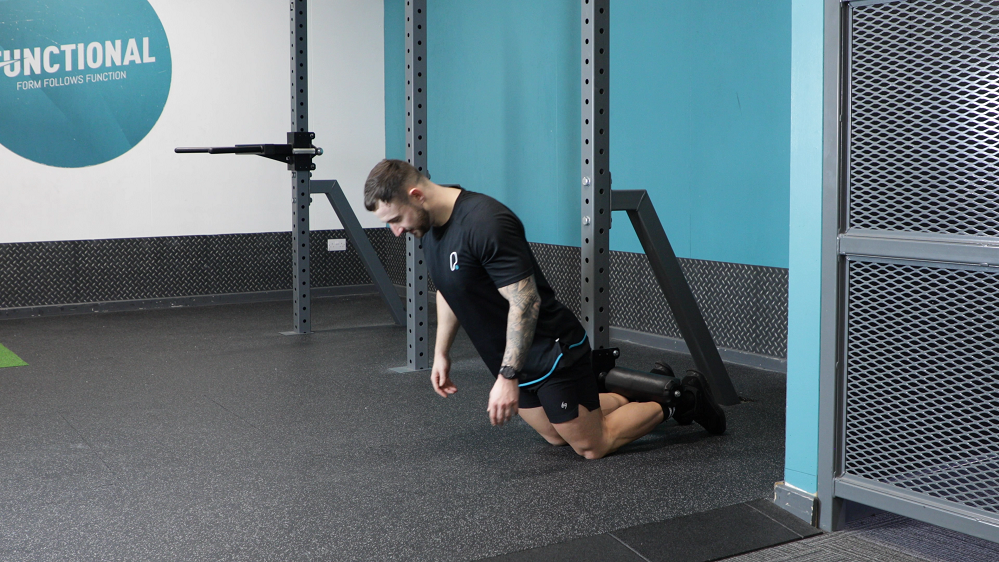
- Nordic hamstring curl: Kneel on a padded surface with your ankles anchored (a partner holding them down works, or a fixed pad). Keeping your hips straight, slowly lower your torso toward the floor, resisting the fall for as long as possible with your hamstrings, then catch yourself with your hands. Start with 2 sets of 3-5 reps, twice a week — volume matters less than consistency, and the exercise is demanding even at low reps.
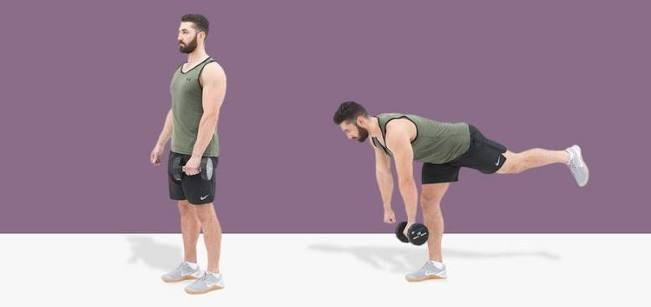
- Single-leg Romanian deadlift: Standing on one leg with a slight knee bend, hinge forward at the hip while extending the other leg behind you, keeping your back flat, until your torso is roughly parallel to the floor, then return to standing. 3 sets of 8-10 reps per leg. This trains the hamstring through a long range under control, closer to running mechanics than a seated curl.
- Sprint-specific build-ups: Once pain-free and cleared for running, progress gradually from jogging to strides to full sprints over 1-2 weeks rather than jumping straight back to top speed — the injury happens at maximum sprint mechanics, so that’s the demand rehab needs to rebuild toward, not skip.

Supporting video: How to Set Up, Perform, & Program Nordic Hamstring Curls ↗
Covers setup, progressions, and regressions of the exercise — watch it in full before linking it, to confirm the cueing matches what you’re recommending to readers.
This article is general information and does not replace an individual assessment. A suspected hamstring strain — sudden posterior thigh pain during sprinting, sometimes with a pop or immediate loss of speed — should be evaluated by a physical therapist or doctor before returning to running or sport.
References
- Ekstrand J, Waldén M, Hägglund M. Hamstring injuries have increased by 4% annually in men’s professional football, since 2001: a 13-year longitudinal analysis of the UEFA Elite Club injury study. Br J Sports Med. 2016;50(12):731-737. PMID: 26746908. PubMed ↗
- Opar DA, Williams MD, Shield AJ. Hamstring strain injuries: factors that lead to injury and re-injury. Sports Med. 2012;42(3):209-226. PMID: 22239734. PubMed ↗
- Askling CM, Tengvar M, Thorstensson A. Acute hamstring injuries in Swedish elite football: a prospective randomised controlled clinical trial comparing two rehabilitation protocols. Br J Sports Med. 2013;47(15):953-959. PMID: 23536466. PubMed ↗
- Petersen J, Thorborg K, Nielsen MB, Budtz-Jørgensen E, Hölmich P. Preventive effect of eccentric training on acute hamstring injuries in men’s soccer: a cluster-randomized controlled trial. Am J Sports Med. 2011;39(11):2296-2303. PMID: 21825112. PubMed ↗
- van der Horst N, Smits DW, Petersen J, Goedhart EA, Backx FJG. The preventive effect of the Nordic hamstring exercise on hamstring injuries in amateur soccer players: a randomized controlled trial. Am J Sports Med. 2015;43(6):1316-1323. PMID: 25794868. PubMed ↗