Why Your Blood’s pH Barely Ever Changes (And What Happens on the Rare Occasions It Does)
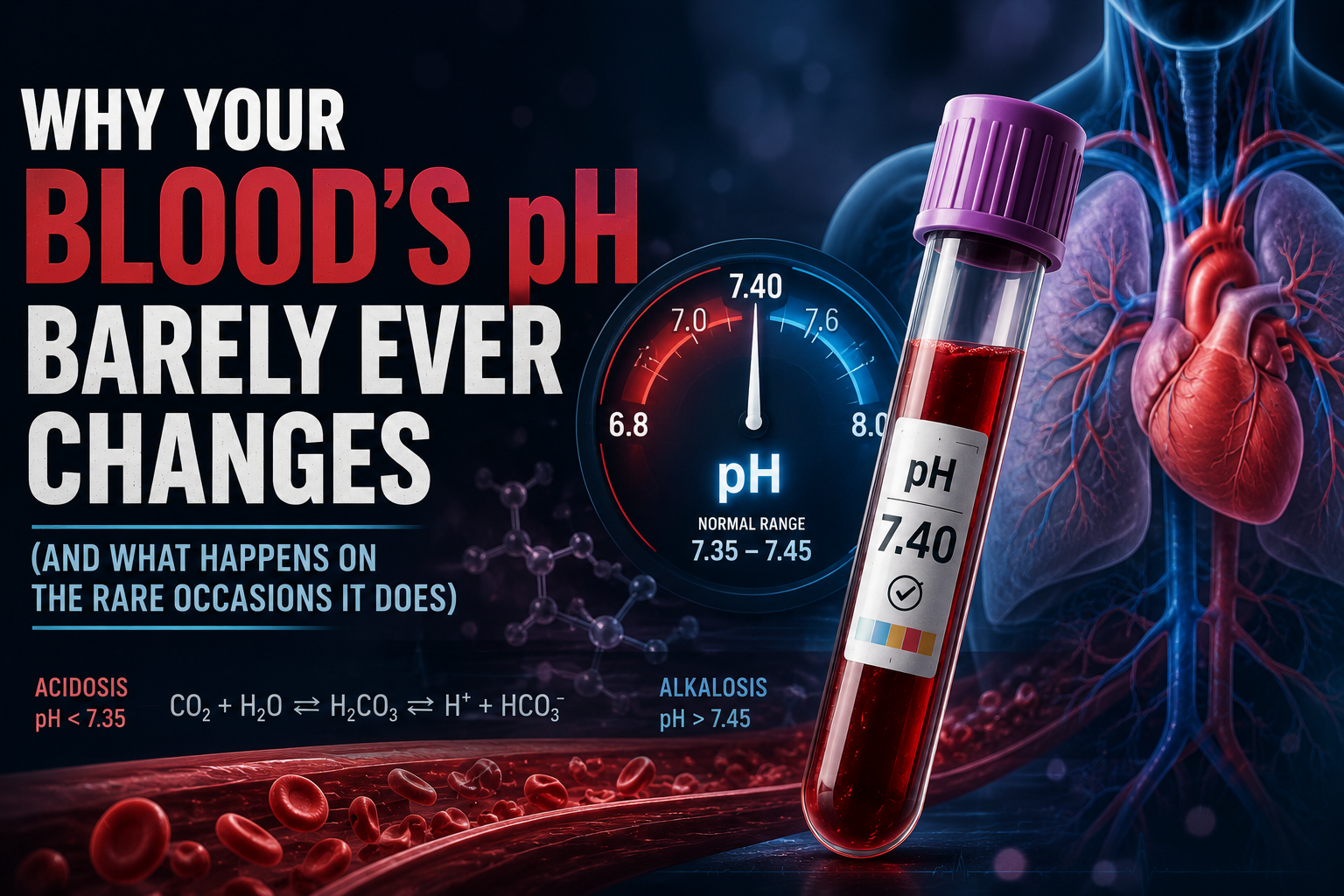
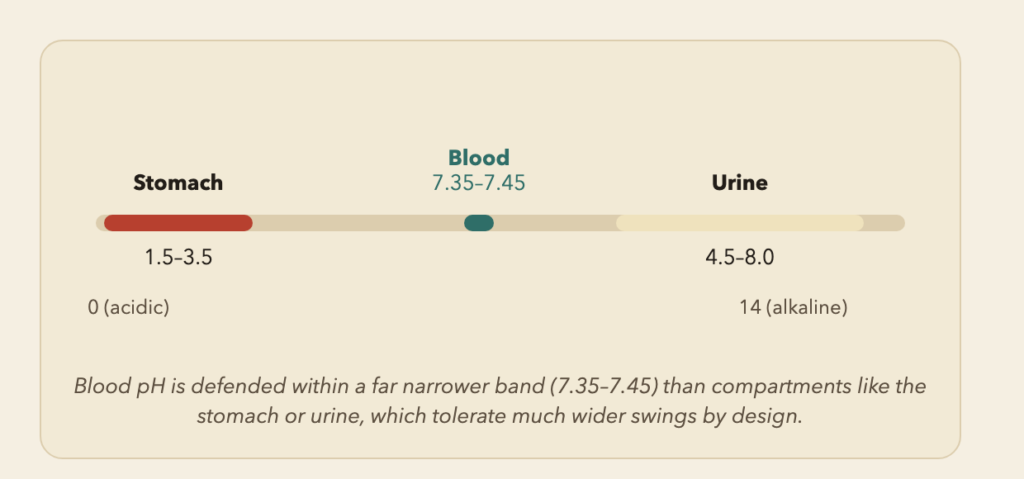
Blood pH sits in an incredibly narrow range, 7.35 to 7.45, no matter how hard you train or what you eat. Here’s what actually holds it there, why the muscle “burn” isn’t lactic acid, and what happens when the buffers get overwhelmed.
Every breath you take, every step you run, and every meal you digest generates acid. Metabolism is, chemically speaking, a constant acid-producing process. And yet if you drew blood right now, mid-workout or mid-meal, its pH would almost certainly fall between 7.35 and 7.45 — a range so narrow that a shift of even a few tenths outside it can impair enzyme function, disrupt nerve and muscle signaling, and become a medical emergency. The fact that this number barely moves isn’t an accident. It’s the output of three overlapping systems working continuously to defend it.
The Problem
Because blood pH is defended so effectively, most people never think about it — until something pushes hard enough to reveal the system underneath. Intense exercise is the most common everyday stress test: anaerobic metabolism floods the muscle with hydrogen ions (H⁺) faster than at almost any other time in normal life, and the burning, heavy sensation that follows is usually blamed on “lactic acid build-up.” That explanation is close, but not quite right, and the actual mechanism says a lot about how the body prioritizes chemical stability over comfort.
Why It Happens: The Evidence
Three systems defend blood pH, each trading speed for precision. The fastest is chemical buffering, dominated by the bicarbonate system, which reacts within seconds: carbon dioxide and water form carbonic acid, which splits into a hydrogen ion and a bicarbonate ion. When acid floods in, bicarbonate mops up the extra H⁺; when the blood turns too alkaline, the reaction runs the other way.
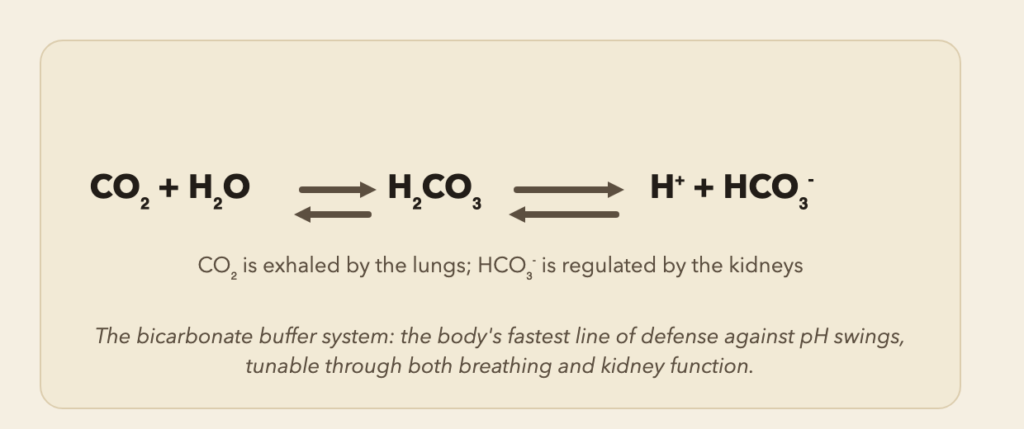
The second system is respiratory: within minutes, faster or slower breathing adjusts how much CO₂ is blown off, directly shifting the equation above. The third is renal — slower, taking hours to days, but the most precise long-term control, as the kidneys selectively excrete or retain H⁺ and bicarbonate.
Exercise puts the first two systems to work hardest. During intense effort, anaerobic glycolysis generates ATP quickly without enough oxygen, releasing large amounts of H⁺ as a byproduct. Contrary to popular belief, it’s these hydrogen ions — not lactate itself — that are primarily responsible for the burning sensation and the inhibition of muscle enzymes during hard exercise; lactate production is actually part of how the muscle buffers and exports that acid load, not the cause of the burn [1]. The popular villain has the wrong name.
That local acidity has a second, separate consequence beyond fatigue: pain. Acid-sensing ion channels (ASICs) are proton-gated channels on the nerve endings that sense tissue damage, and a drop in local pH — from inflammation, ischemia, or fatiguing exercise — directly activates them, which is one of the more direct mechanistic links between tissue acidosis and the sensation of pain [2]. The same chemistry that produces the “burn” during a hard set is, at a lower level, part of how the body signals irritated or damaged tissue.
The Solution
Because the bicarbonate buffer is central to blunting acid during hard exercise, some athletes supplement with sodium bicarbonate directly to raise the blood’s buffering capacity before a race or session. A meta-analysis pooling the available trials found a moderate overall benefit for high-intensity anaerobic performance, though the effect size varies considerably by exercise type, dose, and training status, and is more consistent in trained than recreational athletes [3]. It’s not a tool most rehab patients need, but it illustrates the same principle that applies to any exercise program: buffering capacity is trainable, and pacing intensity to match it is what makes hard training sustainable rather than self-limiting.
For rehabilitation specifically, that translates into two practical levers: matching prescribed intensity to a patient’s current buffering capacity rather than a generic target, and protecting rest intervals long enough for local pH to normalize between hard sets, so the next set is trained at full quality instead of already blunted by residual acidosis.
Exercises
- Work-rest interval pacing: For any high-intensity interval block, keep the rest long enough (60-120 seconds for most functional efforts) for the burning sensation to clearly subside before starting the next repetition — training through unresolved acidosis mostly trains poor form, not fitness.
- Diaphragmatic breathing between sets: Slow, full exhalations during rest intervals accelerate CO₂ clearance from the blood, giving the respiratory arm of the buffer system a head start before the next effort.
- Progressive threshold exposure: Gradually increase the duration or intensity of sets that reliably produce the “burn,” rather than jumping to maximal effort — this is what raises the muscle’s buffering and clearance capacity over weeks, the same adaptation bicarbonate supplementation mimics acutely.
Supporting video: Introduction to buffers — Khan Academy ↗
Walks through the bicarbonate buffer equilibrium shown above in more depth — watch it in full before linking it, to confirm it matches the mechanism described in this article.
References
- Robergs RA, Ghiasvand F, Parker D. Biochemistry of exercise-induced metabolic acidosis. Am J Physiol Regul Integr Comp Physiol. 2004;287:R502-16. PMID: 15308499. PubMed ↗
- Wemmie JA, Taugher RJ, Kreple CJ. Acid-sensing ion channels in pain and disease. Nat Rev Neurosci. 2013;14(7):461-71. PMID: 23783197. PubMed ↗
- Peart DJ, Siegler JC, Vince RV. Practical recommendations for coaches and athletes: a meta-analysis of sodium bicarbonate use for athletic performance. J Strength Cond Res. 2012;26(7):1975-83. PMID: 22505127. PubMed ↗
This article is general information and does not replace an individual assessment. Anyone with a diagnosed respiratory, renal, or metabolic condition affecting acid-base balance should follow their own clinician’s guidance rather than the general exercise pacing described here.