Proteins in the Human Body: Structure, Function, and Muscle Recovery
Learn how proteins are structured, what they do in the body, and why adequate protein intake is essential for muscle recovery and tissue healing in physical therapy.
Of all the biological molecules in the human body, proteins are the most diverse and functionally versatile. They build muscle fibers, form collagen in tendons and ligaments, transmit signals between cells, regulate metabolism, defend against infection, and transport oxygen through the bloodstream. Without proteins, life as we know it would be impossible — and without adequate protein intake, recovery from injury becomes significantly slower.
For physical therapy patients, understanding proteins helps explain why nutrition matters during rehabilitation, why certain exercises build muscle while others don’t, and how the body constructs the new tissue that replaces what was damaged. This article explores the structure and function of proteins, their roles in the musculoskeletal system, and their importance in physical therapy recovery.
What Are Proteins?
Proteins are large, complex molecules made up of smaller units called amino acids. An amino acid is a molecule containing an amino group (-NH₂), a carboxyl group (-COOH), and a side chain (R group) that distinguishes one amino acid from another. There are 20 standard amino acids in the human body.
Amino acids are linked together by peptide bonds — chemical bonds formed between the amino group of one amino acid and the carboxyl group of the next. A chain of two or more amino acids is called a peptide; a chain long enough to fold into a functional three-dimensional structure is called a protein.
Nine of the 20 amino acids are essential — meaning the body cannot synthesize them and must obtain them from food. These include leucine, isoleucine, valine, threonine, methionine, phenylalanine, tryptophan, lysine, and histidine. Leucine is especially important for stimulating muscle protein synthesis.
The other 11 amino acids are non-essential — the body can synthesize them from other molecules. However, under conditions of severe stress, injury, or illness, some non-essential amino acids (like glutamine and arginine) may become conditionally essential, meaning dietary intake becomes critical for recovery.
Levels of Protein Structure
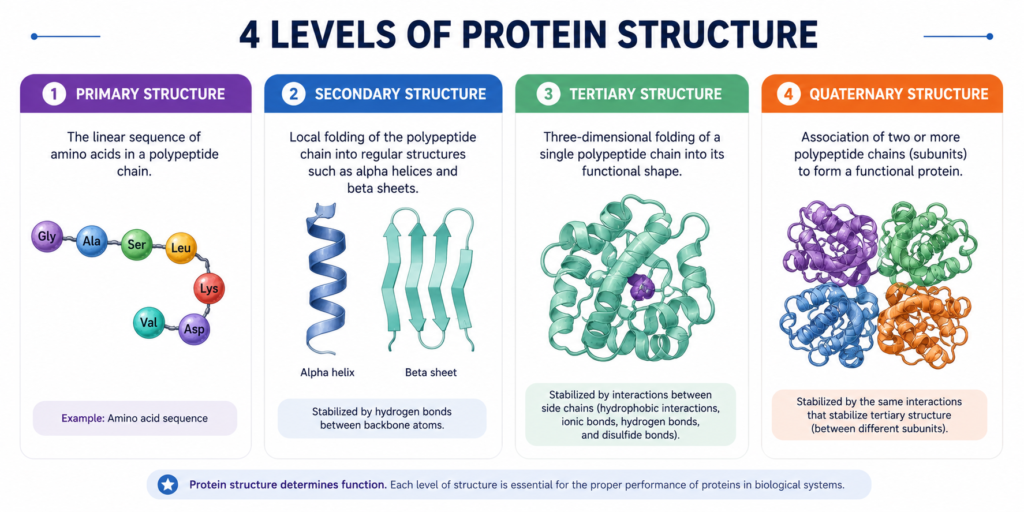
Proteins are not simply chains of amino acids. They fold into precise three-dimensional structures that determine their function. Protein structure is described at four levels:
Primary structure: The sequence of amino acids in the chain — this is determined directly by the gene that codes for the protein.
Secondary structure: Local folding patterns stabilized by hydrogen bonds — most commonly the alpha-helix (a coiled structure) and the beta-pleated sheet (a flat, zig-zag arrangement). Collagen has a unique triple helix secondary structure.
Tertiary structure: The overall three-dimensional shape of a single protein chain, formed by interactions between amino acid side chains (including hydrogen bonds, ionic bonds, and disulfide bridges).
Quaternary structure: The arrangement of multiple protein chains (subunits) into a functional complex. Hemoglobin is a classic example — it consists of four protein chains that together can carry oxygen.
Proteins must fold correctly to function. Misfolded proteins are non-functional and can be toxic — their accumulation is linked to diseases like Alzheimer’s and Parkinson’s. Cells have quality control systems (chaperone proteins and proteolytic enzymes) to detect and degrade misfolded proteins.
Key Protein Types in the Musculoskeletal System
Several proteins are especially important for physical therapy and musculoskeletal health:
Collagen is the most abundant protein in the body, making up about 30% of total protein mass. It forms the structural backbone of tendons, ligaments, cartilage, bone, and skin. There are at least 28 types of collagen, with Type I (high tensile strength, found in tendons and bones) and Type II (compressive resistance, found in cartilage) being the most relevant to physical therapy.
Actin and myosin are the contractile proteins of muscle. Their interaction — powered by ATP — generates the force of muscle contraction. Training increases the content of these proteins in muscle cells, contributing to increased strength and muscle mass.
Elastin is a protein that, like a rubber band, can be stretched and recoils when released. It is found in ligaments, blood vessel walls, and skin. It provides elasticity and resilience.
Fibronectin and laminin are extracellular matrix proteins that help cells adhere to their surroundings, guide cell migration during tissue repair, and regulate cell behavior.
Hemoglobin is the oxygen-carrying protein in red blood cells. It contains iron-rich heme groups that bind oxygen in the lungs and release it in peripheral tissues.
Immunoglobulins (antibodies) are proteins produced by the immune system to neutralize pathogens. Adequate protein nutrition supports immune function — important during recovery, when the immune system is actively engaged in tissue repair.
Protein Synthesis and Muscle Building
Muscle protein synthesis (MPS) is the process by which muscle cells build new proteins — particularly actin and myosin — in response to exercise and adequate nutrition. MPS is the biological mechanism of muscle growth (hypertrophy) and the repair of exercise-induced muscle damage.
The primary stimulus for MPS is mechanical loading of muscle. Resistance exercise — especially when it involves significant muscle tension and metabolic stress — activates signaling pathways in muscle cells (particularly the mTOR pathway) that upregulate ribosomal activity and protein synthesis rates.
Protein intake is the other essential ingredient. After exercise, muscle cells are primed for protein synthesis but require a supply of amino acids — particularly the essential amino acid leucine — to fuel this process. Research consistently shows that consuming 20-40 grams of high-quality protein shortly after a resistance training session maximizes MPS.
For physical therapy patients recovering from muscle injury or surgery, optimizing MPS is a key goal. This requires both progressive therapeutic exercise (to provide the mechanical stimulus) and adequate protein intake (to supply the raw materials).
Protein and Collagen Synthesis for Tendon and Ligament Repair
Tendon and ligament repair depends on collagen synthesis by fibroblasts. The rate of collagen production is influenced by:
- Mechanical loading: Tendon fibroblasts produce more collagen in response to tensile forces — one reason progressive loading is so important in tendon rehabilitation.
- Vitamin C (ascorbic acid): Essential for hydroxylation of collagen precursors, a step required for proper collagen folding and cross-linking.
- Amino acid availability: Glycine, proline, and hydroxyproline are the most abundant amino acids in collagen. Gelatin or hydrolyzed collagen supplementation — particularly when combined with vitamin C and taken before loading exercise — has emerging evidence for supporting tendon collagen synthesis.
Protein Requirements During Physical Therapy Recovery
Most general health guidelines recommend 0.8 grams of protein per kilogram of body weight per day. However, this recommendation is insufficient during rehabilitation from injury or surgery.
Research suggests that patients recovering from musculoskeletal injuries or surgery benefit from 1.6-2.0 grams of protein per kilogram per day — double the standard recommendation. Older adults, in whom protein synthesis is less efficient, may benefit from the higher end of this range.
High-quality protein sources — including meat, fish, poultry, eggs, dairy, and plant-based sources like legumes, tofu, and quinoa — provide the full spectrum of essential amino acids needed to support repair.
Protein Breakdown: The Other Side of the Equation
Muscle protein is continuously turned over — both synthesized and broken down. The net result of MPS and muscle protein breakdown (MPB) determines whether muscle mass increases, decreases, or is maintained.
During immobilization or prolonged inactivity — common during recovery from injury — MPB increases while MPS decreases, leading to rapid muscle loss (atrophy). Physical therapy combats this by providing the exercise stimulus and supporting adequate nutrition that tips the balance back toward protein synthesis.
Cortisol — the stress hormone produced during injury, surgery, or prolonged psychological stress — is a powerful driver of muscle protein breakdown. This is one reason why managing stress and supporting psychological wellbeing is part of comprehensive rehabilitation.
Conclusion
Proteins are the workhorses of the musculoskeletal system — from the collagen that holds tendons together to the actin and myosin that power every muscle contraction. They are built from amino acids supplied by the diet and assembled by the cellular machinery in response to exercise and mechanical loading.
For physical therapy patients, the message is clear: nutrition and exercise are not separate concerns but two sides of the same coin. Adequate protein intake provides the raw materials; therapeutic exercise provides the blueprint; and the body does the rest — constructing new tissue, strengthening existing structures, and gradually restoring function. Understanding protein biology transforms rehabilitation from guesswork into science.
References
- Nelson, D.L., & Cox, M.M. (2021). Lehninger Principles of Biochemistry (8th ed.). W.H. Freeman.
- Berg, J.M., Tymoczko, J.L., Gatto, G.J., & Stryer, L. (2019). Biochemistry (9th ed.). W.H. Freeman.
Disclaimer: This article is for educational purposes only and does not constitute medical advice. Always consult a qualified healthcare professional for personal health concerns.
The site is written and curated by Paul Morgan, a graduate in Physiotherapy (2026), with a particular interest in cardiorespiratory and musculoskeletal physical therapy. Every article on this site is grounded in academic physiology and physical therapy coursework. Content reviewed for clinical accuracy before publishing.