Water in the Human Body: Properties, Functions, and Importance in Physical Therapy
Learn why water is the most essential molecule in the human body, how dehydration affects muscles and joints, and why hydration is critical in physical therapy.
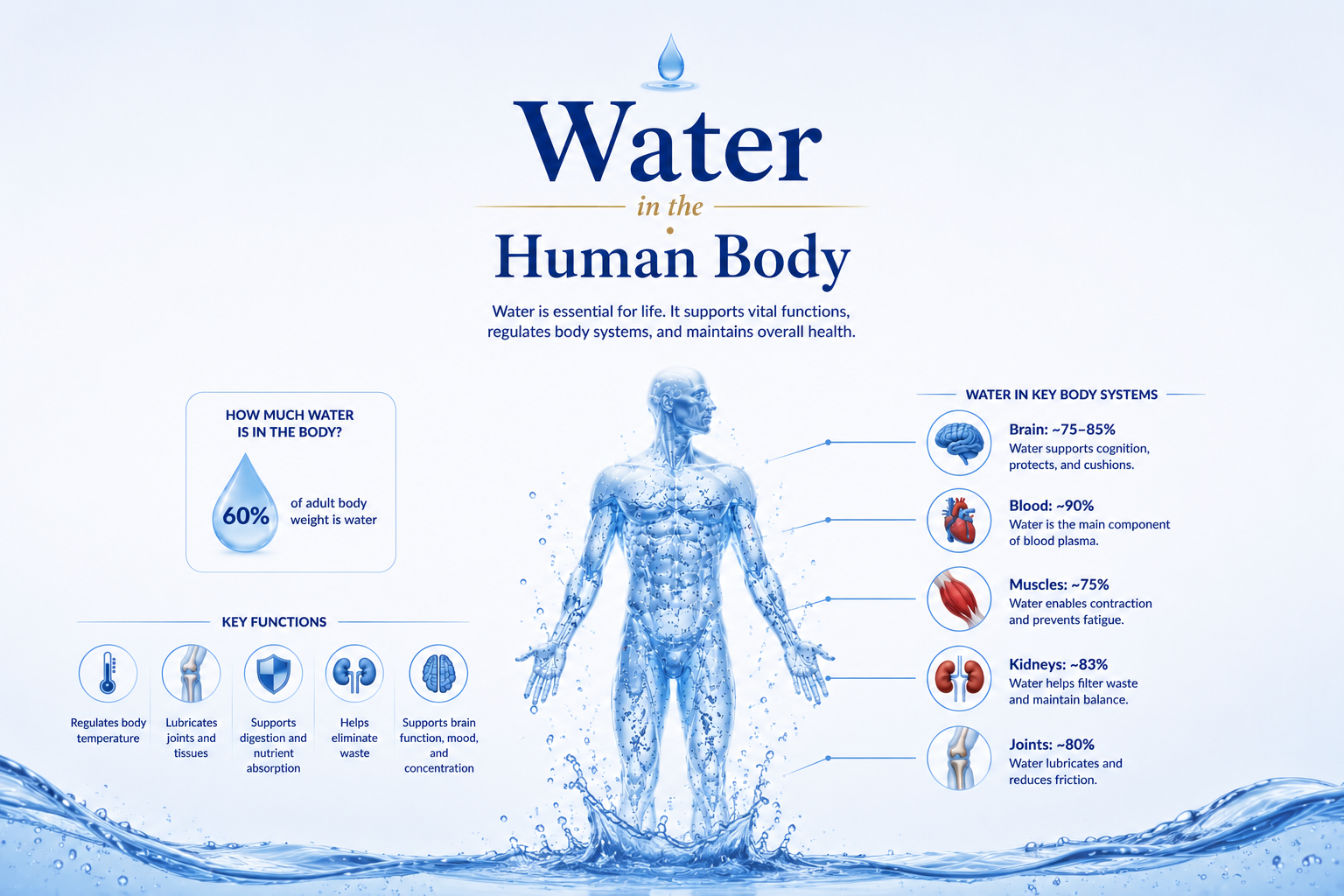
It is one of the most abundant molecules on Earth and the most essential for human life. Water makes up approximately 60% of adult body weight — around 42 liters in an average adult. Despite being chemically simple (two hydrogen atoms and one oxygen atom: H₂O), water has a set of extraordinary physical and chemical properties that make it uniquely suited to supporting all of the biological processes that sustain life.
For physical therapy patients, hydration is not a minor consideration. Water influences joint lubrication, muscle function, nerve conduction, temperature regulation, and the speed at which healing occurs. Understanding why water is so biologically essential motivates better hydration habits — and better rehabilitation outcomes.
The Unique Chemical Properties of Water
Water’s remarkable biological properties stem from its molecular structure. The oxygen atom in water is slightly negatively charged, while the hydrogen atoms are slightly positively charged, creating a polar molecule. This polarity allows water molecules to form hydrogen bonds with each other and with other polar molecules.
These hydrogen bonds give water several properties that are critical for life:
High heat capacity: Water can absorb large amounts of heat without a significant rise in temperature. This buffers the body against rapid temperature fluctuations during exercise.
High heat of vaporization: A large amount of energy is required to evaporate water. This makes sweating an extremely effective cooling mechanism — evaporation of sweat removes large amounts of heat from the body surface.
Cohesion and surface tension: Water molecules attract each other strongly, creating surface tension that is important in the lungs (where it must be overcome for breathing) and in the movement of fluids through fine vessels.
Universal solvent: Water dissolves more substances than any other common liquid. It dissolves ions, glucose, amino acids, hormones, and waste products — allowing them to be transported throughout the body in blood and other fluids.
Distribution of Water in the Body
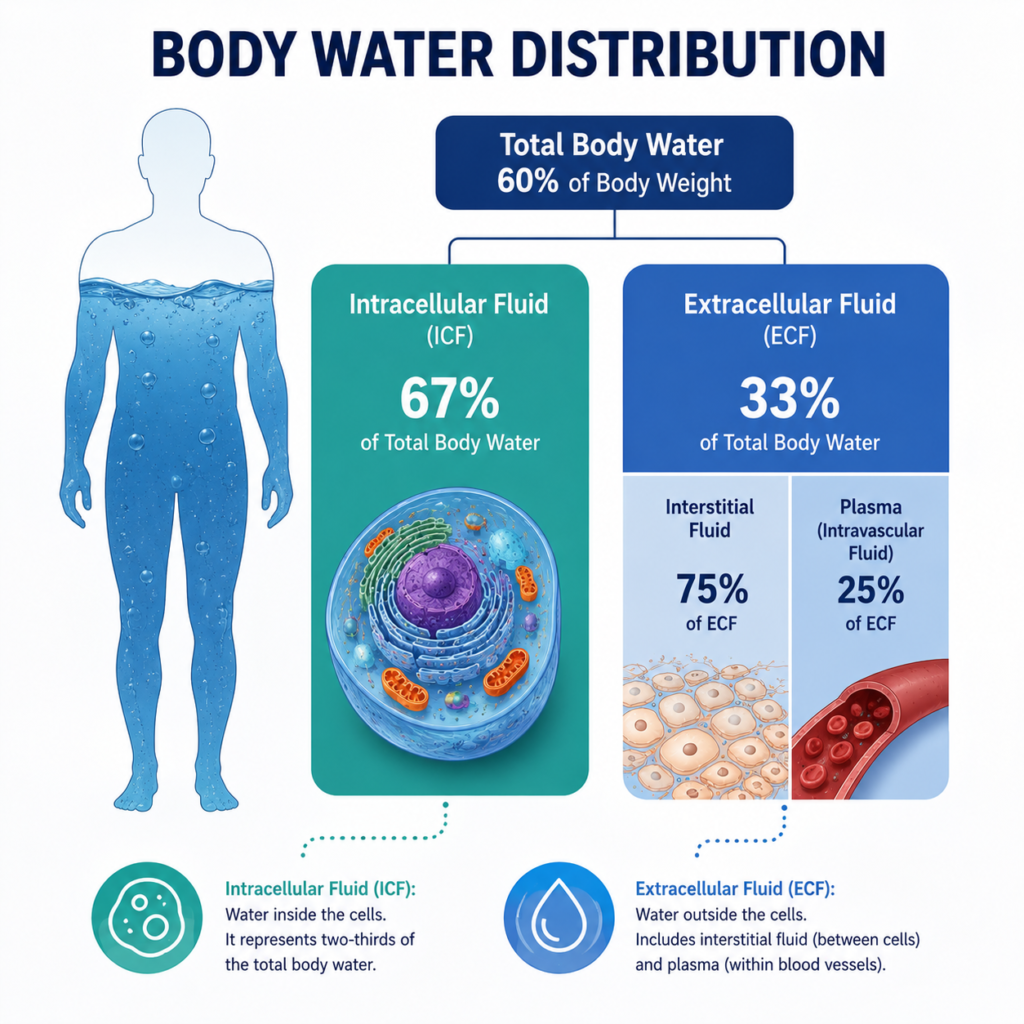
Body water is distributed in two main compartments:
Intracellular fluid (ICF): Approximately 67% of body water is found inside cells. The cytoplasm — in which all cellular reactions take place — is an aqueous solution. Water provides the medium in which enzymes, substrates, and products are dissolved, allowing metabolic reactions to occur.
Extracellular fluid (ECF): The remaining 33% is found outside cells. This includes:
- Interstitial fluid: The fluid that bathes cells in tissues.
- Plasma: The liquid component of blood, which transports cells, nutrients, hormones, and waste products.
- Cerebrospinal fluid, synovial fluid, and other specialized fluids.
The movement of water between these compartments is controlled by osmosis — water moves across semipermeable membranes (like cell membranes) from areas of lower solute concentration to areas of higher solute concentration. This principle is fundamental to understanding edema (swelling), cell hydration, and kidney function.
Water and Muscle Function
Muscle tissue is approximately 75% water by weight. This high water content is not passive — it is essential for the structural and functional properties of muscle.
Water is an integral component of the proteins that form muscle fibers. When muscle cells are dehydrated — even mildly — the structure of these proteins changes, impairing contractile function. Research consistently shows that dehydration as small as 1-2% of body weight reduces muscle strength, endurance, and coordination.
During exercise, muscle contractions generate heat. Water in the bloodstream and interstitial fluid absorbs this heat and carries it to the skin surface, where it is dissipated through sweating and radiation. Without adequate hydration, this cooling system is impaired, leading to premature fatigue and, in severe cases, heat illness.
Electrolytes — sodium, potassium, calcium, and magnesium — dissolved in body water govern electrical signals in muscle cells. These signals trigger the release of calcium from the sarcoplasmic reticulum, initiating muscle contraction. Dehydration concentrates electrolytes abnormally, disrupting these signals and contributing to muscle cramps — a common complaint during rehabilitation.
For physical therapy patients, maintaining good hydration before, during, and after therapy sessions is essential for getting the most out of each session and recovering effectively between them.
Water and Joint Health
Synovial joints contain synovial fluid — a viscous fluid that lubricates the joint, reduces friction between cartilage surfaces, and provides nutrients to avascular cartilage. Synovial fluid is 98% water.
Articular cartilage itself is approximately 70-80% water. This high water content gives cartilage its remarkable ability to resist compressive forces. When a joint is loaded, water is squeezed out of the cartilage and into the synovial space; when the load is removed, water is reabsorbed. This fluid flow not only distributes load across the cartilage surface but also delivers nutrients to cartilage cells (chondrocytes), which have no direct blood supply.
Dehydration reduces both synovial fluid volume and cartilage hydration, increasing joint friction and reducing the cushioning effect of cartilage. Over time, chronically dehydrated cartilage is more susceptible to damage and degenerative changes. This is one reason why maintaining good hydration is important for patients with osteoarthritis, knee pain, or hip joint conditions managed in physical therapy.
Water and the Intervertebral Discs
The intervertebral discs — the cushioning structures between vertebrae in the spine — are also predominantly water. The nucleus pulposus (the inner gel-like core of each disc) is 70-90% water in young adults, decreasing with age.
Spinal discs undergo a diurnal cycle: during the day, gravitational loading compresses the discs and squeezes out water. During sleep (when the spine is unloaded), water is reabsorbed. This is why people are typically 1-2 cm taller in the morning than in the evening.
Adequate hydration supports disc height and shock-absorbing capacity. Chronic dehydration contributes to disc degeneration — a precursor to conditions like disc herniation and lumbar stenosis, which are common conditions addressed in spinal physical therapy.
Hydration Needs During Physical Therapy
The general recommendation for daily water intake is approximately 2.5-3.5 liters for adults (including water from food), but this increases significantly with exercise:
- Mild exercise: Add approximately 0.5-1 liter per hour of activity.
- Moderate exercise (typical physical therapy session): Add 0.5-1 liter, replaced before, during, and after the session.
- Hot conditions or heavy sweating: Increase intake further; monitor urine color (pale yellow indicates adequate hydration; dark yellow indicates dehydration).
Thirst is not a reliable early indicator of dehydration — by the time you feel thirsty, you may already be mildly dehydrated. Physical therapy patients should develop the habit of drinking water regularly throughout the day rather than waiting for thirst.
Patients on certain medications (diuretics, which increase urine output) or with conditions affecting fluid regulation (heart failure, kidney disease) should follow hydration guidance from their medical team.
Water, Inflammation, and Tissue Healing
Water is essential to the healing process at every stage. Inflammatory fluid (edema) delivers immune cells and growth factors to injured tissue. Adequate blood plasma volume (which depends on hydration) ensures efficient delivery of oxygen and nutrients to healing tissue. The lymphatic system — which drains excess fluid from injured tissues — requires good overall hydration to function efficiently.
Dehydration impairs all of these functions, slowing the healing process. Physical therapists may observe that dehydrated patients show slower progress, more pronounced muscle soreness, and reduced exercise tolerance.
Conclusion
Water is not merely a passive solvent — it is an active participant in virtually every biological process that supports physical therapy recovery. From lubricating joints and hydrating cartilage to fueling muscle contractions and facilitating healing, water is the medium in which all of the body’s remarkable chemistry takes place.
For physical therapy patients, the practical message is simple but powerful: drink enough water. Maintaining adequate hydration before, during, and after therapy sessions is one of the simplest and most effective actions you can take to support your own recovery. In rehabilitation, as in life, water is the foundation of everything.
References
- Nelson, D.L., & Cox, M.M. (2021). Lehninger Principles of Biochemistry (8th ed.). W.H. Freeman.
- Berg, J.M., Tymoczko, J.L., Gatto, G.J., & Stryer, L. (2019). Biochemistry (9th ed.). W.H. Freeman.
Disclaimer: This article is for educational purposes only and does not constitute medical advice. Always consult a qualified healthcare professional for personal health concerns.
The site is written and curated by Paul Morgan, a graduate in Physiotherapy (2026), with a particular interest in cardiorespiratory and musculoskeletal physical therapy. Every article on this site is grounded in academic physiology and physical therapy coursework. Content reviewed for clinical accuracy before publishing.