
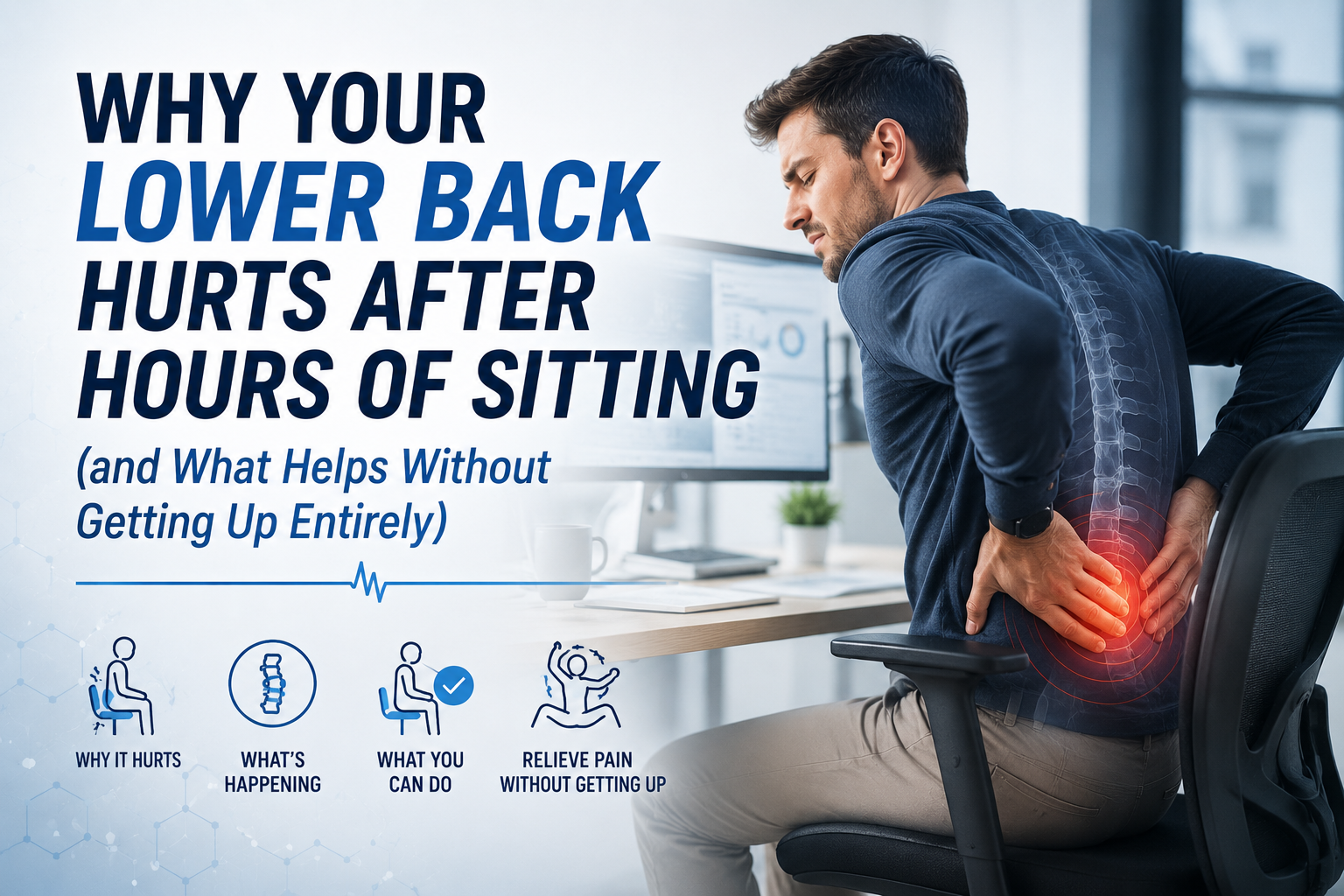
Why Your Lower Back Hurts After Hours of Sitting (and What Helps Without Getting Up Entirely)
Sitting for long periods physically changes how stiff your lumbar spine becomes. We explain why, with the science, and what movement reverses it.
You don’t need to lift anything or move the wrong way for your lower back to start complaining. Sometimes just staying still is enough. If you work seated, it’s probably the most frequent physical complaint of your week, and it has a very specific mechanical explanation.
The Problem
The longer you sit without changing position, the stiffer your lumbar spine becomes — literally, not figuratively. That stiffness isn’t just discomfort: it’s a measurable change in how the tissue of the lower back behaves, and it shows up sooner than most people think.
Why It Happens: The Evidence
A study published in The Spine Journal measured passive flexion stiffness of the lumbar spine before and after prolonged sitting. In the men in the study, stiffness increased measurably after just one hour of sitting without moving; in women, the response was more variable across a two-hour trial. The researchers note that this stiffness increase could raise the risk of low back injury upon standing up or resuming movement, precisely because the tissue no longer responds with the same flexibility it had at the start of sitting.
The Solution
A study published in the European Spine Journal tested a surprisingly simple intervention: instead of asking people to stand up periodically, they had the chair itself apply a gentle rotary dynamic stimulus while seated — an almost imperceptible movement that kept the spine from staying fully static. The result was a reduction in pain during long sitting sessions, especially with the lowest-frequency stimulus, compared with staying completely still.
The practical takeaway isn’t that you need a special chair: it’s that the real enemy is total stillness, not sitting itself. Frequent micro-movements — shifting your weight side to side, gently rotating your torso, lifting and setting your feet down — serve the same function as the rotary stimulus in the study.
Exercises
- Seated trunk rotation. Sitting with feet planted, gently rotate your torso to one side while holding the back of the chair, hold 5 seconds, and repeat to the other side. Do this every 30-45 minutes.
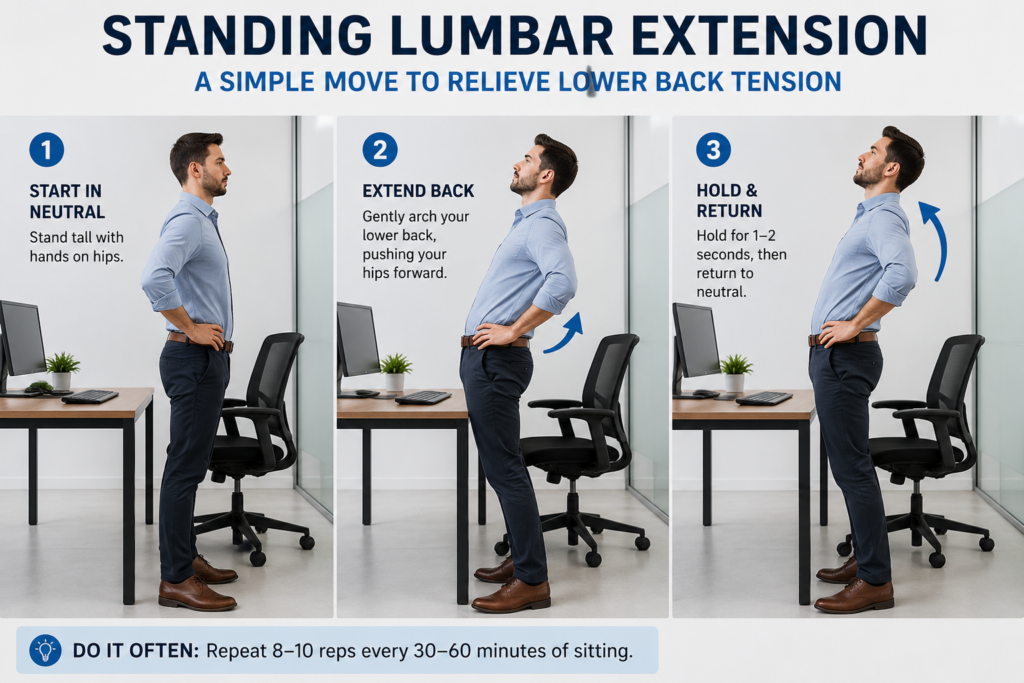
- Standing lumbar extension. Every hour, stand up, place your hands on your lower back, and gently arch backward for 3-5 seconds, repeating 5 times. This directly reverses the sustained flexion of sitting.
- Gentle cat-camel. Standing or on all fours if possible, alternate arching and rounding your back slowly and with control, 8-10 repetitions, to restore segmental mobility to the spine.
Supporting video: 4 Exercises to Fix Back Pain From Sitting All Day ↗
Watch the full video before linking it to confirm the exercises match those described above.
References
- Beach TA, Parkinson RJ, Stothart JP, Callaghan JP. Effects of prolonged sitting on the passive flexion stiffness of the in vivo lumbar spine. Spine J. 2005;5(2):145-154. PMID: 15749614.
- Van Deursen LL, Patijn J, Durinck JR, Brouwer R, van Erven-Sommers JR, Vortman BJ. Sitting and low back pain: the positive effect of rotary dynamic stimuli during prolonged sitting. Eur Spine J. 1999;8(3):187-193. PMID: 10413343.